31.10.10

S.T.A.L.K.E.R.: Shadow of Chernobyl + Call of Pripyat, Metro 2033: I’d like to go home, I’ve mined the graveyard of unpublished poems

здравствуйте! As an American watching too many Hollywood films for one lifetime and being surrounded by events such as outsourcing, everyday judgments about foreign lands lean to the side of mostly harsh and are much easier to find than free chocolate for a hungry woman.  So when a company comes around from a land that would take a very long plane ride to reach, it’s easier to dismiss and distrust than even give the game and company half a chance.  Now compound that with a former foreign political party that forced the popular duck and cover movie that our parents or grandparents enjoyed thinking while trying to sleep produces even more happily earned motivation to buy anything coming from the CCCP.   

As an American with a specialized background, I’ve been forced to sit through training dealing with one of the worst industrial accidents in the last century: Chernobyl.  Within the stacks of paperwork there are plenty of videos such as this one and this one, etc, all bringing the events of the disaster to a very eerie realization.  The nearby town Pripyat for example, was created to give workers of Chernobyl a place to call home but has remained abandoned since it was evacuated a day after the accident.        

With all that smile friendly news enters the company GSC Game World from Kiev, Ukraine.  After running some searches of games developed in Ukraine the overall list seemed smaller than Mega Millions winners from the Midwest.  And it wasn’t too long ago that a Russian speaking company pushed my typical easy going nature to the edge of “bad touch” boundaries.  But the strength of persuasion can come from many avenues even those that are less expected.  Irrational Games’ podcast was the first place to drop not only GSC’s name but a very specific game that influenced Bioshock. 
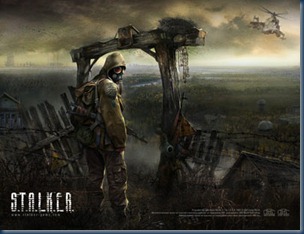
stalker socThat game Irrational mentions on multiple occasions is S.T.A.L.K.E.R.: Shadow of Chernobyl for the PC.  At first glace, minus for those coming out of their Y2K bunkers in time to resupply for 2012, one can easily see that S:SC was released back in 2007.  But before brushing off what looks like a dated game compared to today’s standards there is hope.  An additional free download (considered a mod but is more like a total overhaul) is available from a large group of freelance developers here.  After updating this three year old game to visually mimic today’s games, S:SC begins to play a sly game of unravel the mystery.  But do not go into S:SC thinking it’s a typical “your a good guy, here’s some bad guys, go kill and we’ll fill you in on why later.”  S:SC in fact has lot of depth, girth, berth and whatever other awkward synonyms for wideness you can muster up when it comes to its central theme.

There are some core elements from a few different places that become interlaced within S:SC.  The first chunk comes from a 1979 (prior to Chernobyl) Russian movie called Stalker.  Skipping over the need to watch the entire movie, Stalker was about three characters intent on trying to reach a place called “the room” within a quarantined wilderness because of its rumored ability to grant any wish to those who enter it.  A very interesting side note (according to wikipedia) is after filming this movie, some of the cast and crew died from various types of respiratory disorders which they had believed to have come from a scene filmed near a discharge river used by a nearby chemical plant as it was said to have been snowing in summer.   

stalker soc 2The second piece of S:SC’s storyline comes already aforementioned accident of Chernobyl and that part may be a bit obvious just from reading the title of the game.  So yes, S:SC is set in the “area” of today’s Chernobyl where the military will stop any random civilians from gaining access to the highly irradiated and dangerous area.  With Chernobyl comes all the abandoned buildings and power plant itself to be explored along with the frequent need to watch the old Geiger counter. 

And the third puzzle piece of the central theme is the sc-fi book Roadside Picnic.  Going straight to the cliff notes, Roadside Picnic is about the concept of a messy family going on a picnic in the woods.  They arrive and animals scatter and hide to and fro while the family stays for a while, eats, and then blazes off leaving all sorts of trash behind.  The animals then slowly come out to inspect what was left behind, objects foreign to them, each having different dangers or benefits.  For example a half eaten sandwich is consumed like any other food, but a mostly empty can of motor oil when sniffed and licked makes the animal very sick.  Roadside Picnic is that same concept only with aliens and people.  A group of visitors come to Earth at various locations, stay just long enough to be noticed and then quickly take off.  People then begin to explore the areas to find strange artifacts left behind.  Some are very dangerous while others have very odd benefits.  Once this is realized, the areas become exclusion zones guarded by respective militaries.  A group of known as stalkers, once again, are the only ones who venture purposely into the zones in hopes to find artifacts to bring back to sell.

stalker soc completeThese three concepts make up the backdrop for S:SC.  The game takes place in Chernobyl, a true exclusion zone, and you play a S.T.A.L.K.E.R. who is found by a merchant on the edge of the zone.  Awaking with a bit of amnesia you find a message on your PDA saying to kill a fellow S.T.A.L.K.E.R.  The merchant gives you a slight introduction into the zone telling you to be on the lookout for artifacts that hold powers to be sold for high prices.  From there the game is a sandbox FPSer where quests are given with specific times by which they must be completed and it is the players choice to solve the mysteries of S:SC or run around randomly in the name of democracy to put a bullet in anything sounding Russian. 

And everything in this game does sound as Russian as this folk song.  Even when choosing to play this in English, many of the NPCs are not translated in the random small sayings as they wander by or some of the dialog text.  As you stand by allies within a camp, one will on occasion pull out a guitar to sing a song to make you feel like Kansas is oh so far away. 

stalker soc 4This makes for an interesting environment as it gives a foreign land feel but some smaller parts of the game stay lost in translation.  The initial learning curve of the game is high since much of what is going on starts and stays mysterious but at the same time adds to the ongoing element of horror with its little explanation.  One such problem with translations and storyline I encountered was that I was never able to find the main person to kill and yet was able to end the game a different way.  This disconnect was slightly frustrating but with the aid of our old pal The Internet, the second time through made more sense. 

The horror element is what Irrational Games pointed out as a key piece to what makes a this a memorable game.  True to their word S:SC is one of the scariest games I have ever played.  When it’s 3am with all lights shut off and a few too many cold ones the scary portions of any game will be enhanced because of the surrounding environment the game is played in.  S:SC does not need any enhancement.  Other games such as Resident Evil, FEAR or even Eternal Darkness use very standardized, flashy Hollywoodish, or unique out-of-game scare tactics.  S:SC uses an indirect method with heavy attention to the lack of sounds or focus towards a person’s ability to recognize the cause of a sound.  This is compounded by the fact that S:SC is a survivor oriented game constantly leaving the player with limited ammunition, hunger, bandages, weapon durability, overall health, and a small carry limit.  Additional mods can be applied to S:SC bringing the survivor portion to a more post-apocalyptical standard possibly forcing the player to kill a fellow ally for his food in order to suppress life threatening hunger.  The horror portion is also shadowed by the background of Chernobyl.  GSC Game World took a lot of extra time in researching and even visiting the exclusion zone to ensure the player is given a real and dangerous place that many know about but develops into an even scarier place they more intimately familiar they become with it. 

stalker soc 3The general aspects of S:SC (as long as the complete mod is installed) are run-of-the-mill for today’s standards.  The graphics with weather effects and time of day changes are visually stunning.  The sounds and music are very unique to S:SC due to its origin but are nonetheless high quality.  The controls are customizable and aiming is strong due to the mouse/keyboard combination of PC games.  The combat realism is quite astounding as bullet trajectories matched with proper caliber and gun choice as well as only having iron sights or limited scopes are again an effect of S:SC being a survivor based game.  The multiplayer is more muted due to its age but this is an unnecessary addition as the emotional ties are focused within the single player direction.  The AI is well done  being accurate and tactful.  Overall difficulty is quite high and only gets higher with additional mods but this added challenge is a welcomed one from the simple quick fix FPS games of today.  The storyline is also unique and is directly derived from the previously mentioned core elements but is not coupled with many cutscenes compared to most games of today.     

Rarely does a game three years old peak such a late interest now that Microsoft, Sony, and Nintendo are well enough established with this generation’s consoles.  And sadly this summer was a busy one for me and therefore this review comes at a conflicting time with the upcoming heavy hitting holiday releases instead of during the summer when nothing outstanding was released.  But if anything, S.T.A.L.K.E.R.: Shadow of Chernobyl should stay in the back of your mind like an amazing commercial that sticks in the craw the next time there is a lull in your gaming life.  It is a one of a kind creation that deserves the title of classic and is worth not just one but a few plays through. (Available on Steam)    

Rating: 9.5 {on a scale of –10 to 10}

Three years later (skipping Clear Sky due to known bug issues) a direct sequel called S.T.A.L.K.E.R.: Call of Pripyat was released by GSC Game World.  Much of the gameplay, horror and survival aspects are the same as S:SC but of course some improvements have been made.  This time you are a military agent posing as a S.T.A.L.K.E.R. to investigate the disappearance of lost helicopters that were flying over the town of Pripyat.  The town and surrounding rural areas are again realistically imported as the play environment including one of the most famous Ferris Wheels in the world.  Not long ago Modern Warfare 1 included Pripyat as part of its story allowing you to make your way through some of the abandoned buildings but its graphical engine made the town gleam instead of the grimy reality that S:CP paints. 

stalker copThe graphics of S:CP are a step up over the original (unmodded) as well as the continuity of the story and translations with NPCs.  Gun and armor modification as well as an RPG interface with stats are good improvements but overall the game doesn’t connect on the same level as S:SC.  A majority of the game is spent outside of Pripyat and once the player arrives, exploration of all the visual landmarks comes mostly from player’s curiosity instead of being driven there by the main story. 

The disconnect may come from the simple fact that GSC made it rain in S:SC by letting you waltz all the way into Chernobyl and then expects you to be overjoyed by making it rain with scratch tickets in the abandoned neighboring town.  The mighty dollar rains and reigns better so if you decide to play S:CP, you’re rolling the dice on finding the same amount of pleasure that you can get out of S:SC. (Available on Steam)

Rating: 4.0 {on a scale of –10 to 10}

metro_2033_1The latest and vastly different game released by THQ and 4AGames (founded by former developers of GSC) after S:CP was called Metro 2033.  This release was more of an accessible horror/survival game in order to reach a broader audience than the previously mentioned games being released on consoles as well as PC.  The play environment is again Russian based taking place very near Moscow yet most of the player’s time is spent underground as its title hints at.  In Metro 2033 you play the child of a survivor after a terrible apocalypse ravaged the world’s surface. The survivors of Russia have hid themselves within the nearby metro tunnels of Moscow scraping by with their trusty thirsts being quenched by whatever little vodka they can find.

m2033aChanging from a sandbox game to a very linear one, Metro 2033 still focuses much of its gameplay within the horror genre.  A very dark game graphically forces the player into the same realm of Doom 3, Resident Evil, Silent Hill, etc, where most of the scares are caused by visual panic from enemies having the same working distance as a dance partner.  A unique feature in Metro 2033 is a flashlight with what seems like the shortest battery ever but can be recharged by hand.  This creates situations where in the midst of battle, time management of the player’s visual aid must be taken into account.  Another unique feature is managing a needed gas mask’s chemical cartridges in order to stay on the surface or within oxygen deprived tunnels.  The player’s breathing becomes the ambient noise when the mask is on and adds a new source of tension as changing situations shift the rate.

Metro-2033_3The story is a bit interesting but has a very odd ending not causing any type of beckoning to replay Metro 2033.  A single play through is all that’s really necessary and can be done in about 10-12 hours based on difficulty chosen.  Most of the game is very close combat forcing gun preference toward shotguns over assault rifles or long range sniper weapons purely for spread fire room clearing.  In all the FPS games over the years, Metro 2033 takes the cake as far as keeping the buckshot flying.  I used so many shells that for the next few games that I played I swore off the sound of an empty shell hitting the ground.  The controls are simplified and sometimes slightly awkward on the console as everything is jammed onto a controller.  The AI is good at flank techniques yet not impossibly difficult when they outnumber.  

The overall game is fun but an unnecessary one to play through unless one is a large fan of the genre.  Rent it if slightly interested, but skip it over S:SC if time and cash is limited.  What Metro 2033 does do indirectly is point out that GSC Game World and 4AGames should be around for years to come making quality games from across the back pond.  Even if they are bloody reds they do know how to make a good horror/survival game.  (Available on Steam)       

Rating: 4.5 {on a scale of –10 to 10}

Menomena – Dirty Cartoons

Album Version

13.7.10

Splinter Cell: Conviction + Alpha Protocol: Your will to speak clearly exposed too much, unsung once too often could not rub off

A spy game is a challenge all on its own by having to mix entertainment, reason and sensibleness with a pinch or two of mystery.
Comparisons using different eras of Ian Flemming's James Bond movies, the quality of a "spy" game can mimic the suaveness of Sean Connery, be over the top ridiculousness of Pierce Brosnan, the straight professionalism of Roger Moore, or become the slick modern spy of Daniel Craig.  Some games utilize their spycraft in unique ways that seem plausible while still maintaining dignity but others are so outlandish and confusing they are thrown to the wayside quickly.  Recently two titles have been released, one being a sequel to a long series of stealth and gadgetry and the second being a newcomer from a company with an interesting history.

Splinter-Cell-Conviction-freez The first, Splinter Cell: Conviction from Ubisoft, was released back in April of this year and is the fifth game in the series.  A continuation of the storyline is the core of this series and yet this game branches off in a vastly different direction from its predecessors with regards to gameplay.  Where previous SC’s were very stringent on plausible deniability, this title cares little for consequence when leaving piles of bodies and yes up to Drowning Pool amounts of bodies may hit the floor.  Your average security guard or even U.S. solider can be given a headshot with no recourse.  Bodies no longer have to be hid or cameras bypassed to help keep the stealthy approach rolling since most alarms only create more roadblock targets instead of game over failures.  This guiltless pleasure and freedom to its possessor works in two different ways.  It steps away from what this series was known for to create a more accessible game to the casual gamer yet breaks the continuity of the previous four games to a slightly unreasonable or illogical approach.  But yes, one must accept the rules set forth by their creators. 

splinter-cell-conviction-screenshot But don’t spend so much time dwelling on those five orphans you’ve just created, because it was done so using a new feature in SC:C called ‘mark and execute’ where previously flagged enemies can be simultaneously taken down with the push of a single button.  SC:C also adds a new feature where storyline and checkpoints are illuminated on the walls of your current surroundings instead of breaking the action with loads of cutscenes.  Graphics are pristine for a 3rd person shooter while the sounds and music are present but nothing special much like your favorite television parents Jon and Kate Gosselin.  The controls are slightly awkward like all SC games using odd default button arrangements.  The overall difficulty is no where near the previous games since guns blazing is a more viable option sending stealth to the achievement playground.  This ease may be a warm welcome to veterans of SC but with very little reloads or respawns, the game can be accomplished quickly (less than 12 hours).  The addition of a Co-op only portion of the story is a bonus but unnecessary to accomplish the single player game.      

splinter-cell-conviction The story plays out as a nice continuation but is somewhat predictable in its entirety.  Where the good spy novel or movie presents its story in the fashion of an enigma, SC:C’s story would only feel that way to someone new to the spy or even suspense genres.  For the player that’s new to SC, the story will give slight confusion until it reaches its fruition and for fans of the previous games, will feel almost as if the story is now complete.  Obviousness like the alter egos of Bruce Wayne or Edward Nigma aside, the presentation flows well with the gameplay.  The pre-mission customization of equipment is great but the preference for silent weapons versus the tornado siren of an unsilenced one keeps the choices limited. 

Overall, Splinter Cell: Conviction is a handful of changes, steering the series in new directions that are a big step away from the original.  It is a very short ride like some rounds on the Bill Paxton pinball machine but none of the new features make this title in the Splinter Cell series one that is unforgettable like the first.  It is worth a single play through, especially for fans of the previous games, but this is definitely not a game that will be missed and doesn’t drive the need to replay or compel a player to spend time on other single player modes or even bother with the multiplayer mode more than once.  And where does this fit in the realm of comparisons to spy movies?  Splinter Cell: Conviction is probably the typical Roger Moore spy of a game so rent it if it tickles your fancy.

Rating: 5.0 {on a scale of –10 to 10}      

alphaprotocollogo The second spy game first needs to have its company established to give a proper background.  Alpha Protocol was released by Obsidian Entertainment on June 1st, an offshoot of Interplay.  Obsidian Entertainment has created games like Knights of the Old Republic 2 and Neverwind Nights 2 and the soon to be Fallout 3: New Vegas.  Why they have been allowed to create entire standalone sequels with the same title made by Bioware should start to perk up ears and make itchy heads since franchises, especially very successful ones, tend to keep high amounts of money flowing by making their own sequels.  Quite simply, Obsidian was formed from a group of employees that Interplay laid off: Black Isle Studios at the time.  Bioware purchased some rights to games like Fallout while Obsidian maintained some rights being they were from the original company that produced Fallout.  It’s all confusing as far as intellectual rights are concerned but understanding that Alpha Protocol is a 3rd person action spy game with RPG elements created by a unique company that has been on the cusp of outstanding RPG titles is important.

Alpha Protocol created a lot of possibilities and hopes as it was a new venture by creating a new crossover of genres.  No other company has attempted to mix RPG storytelling and customizing with an action spy game.  There have been plenty of other action games but no RPGs centered on the idea of espionage.  The only other RPGish spy game that comes to mind is Super Sneaky Spy Guy which contains no action while you stare at real photographs to unravel the mysteries of an empty cruise ship.   

Alpha protocol Cutting the fat before I drag this out, Alpha Protocol is not a game for very many people.  There are three distinctive portions of this game:  The 3rd person action, the storytelling system, and the RPG elements.  Few people will enjoy AP due to large problems that truly are surprising for a company that has had their act together in the past.  To put it bluntly the action parts of AP have a lot of issues; Graphics look old, the physics, combat, and camera control feel like riding a classic willy’s jeep on a rough road, the music and sound are so so, bits of the voice acting sound worse than local radio commercials, extremely linear paths for each level, and the AI enemies when not alarmed by your presence patrol rigid paths making 180 degree turns faster than a blink of an eye.  It all adds up quickly to a pile of annoyances much like a long trip to the bathroom with only a creepy Celine Dion Anne Geddes book to pass the time.  These problems do not make the game unplayable, but instead give obtuse glares from the shadows while gremlin laughter can be heard but not seen.  

alpha-protocol-prev-07 At the same exact time where this game begins to fail, it also dabbles in something great.  KOTOR and other Bioware titles use a very simple system of RPG dialogue unfolding the story in various directions while the player makes choices on what type of character to be.  AP takes this a step further removing the scripted choices.  AP instead forces timed attitude responses on the fly that are reactive to the current dialogue.  For example, if a mysterious new character enters a scene and says to leave this town or die, your choices can be sarcastic, professional, or aggressive in nature with the actual responded dialogue unknown until after you’ve made a choice on the type of response.  The choice made can affect your relationship with that person in a neutral, positive (I like you), or negative (I loathe you) direction which also affects how much of the story is revealed from that character and future conversations with other characters.  This system is slightly overshadowed by awkward voice acting at times but ignoring the spoken word and focusing on the written subtitles will keep an RPG lover enthralled.  This system is very interesting and creative, working excellently in the spy genre and makes for a unique presentation of storytelling.  The ‘true’ story in AP is a well kept secret hitting on the unpredictability of a Robert Ludlum level of storytelling for a game.  Hopefully this will be implemented into future games (aka future Fallout games) because there is truly nothing else like it.    

The other RPG elements are tiny glimmers of hope even if the visual portions were slightly lacking.  Customizable guns and equipment (even if all weapon mods are identical looking), unlockable attribute bonuses, a competitive black market of equipment and intel, and an in-depth stat system that records all of the fatherless children you’ve created are among some of the high points of AP.  Sadly all of these RPG pieces are interlaced in the 3rd person action and errors and bugs become easier to focus on than successes.  The black market, for example, contains intel items such as maps or dossiers on characters yet options like maps are unnecessary since all levels are linear in nature.

alpha_protocol-475240 The game can be completed in vastly different manners, ranging from not killing a single person in the whole game (using tranquilzer rounds), to ensuring all beating hearts become bleeding ones.  Regardless of picking a full, empty or somewhere in between kill-count, stealth or disregard of stealth can be chosen much like SC:C but in AP’s case affects the outcome of the game as well as the difficulty and speed of completion.  Guns blazing, this game can be finished in ten hours or less and the stealthy reserved approach pushes completion time beyond ten hours to about fifteen.  Either way the only reason this game would be replayed (I finished it from start to finish twice) is to change all of the hefty dialogue choices and outcomes to better grasp the story yet this is probably unnecessary for anyone who dislikes punishment. 

All in all, Alpha Protocol seemed like it was originally created from a dialogue and storytelling system that will rival future games to come but became a laughing stock of action games for this generation of games by poor implementation of a 3rd person shooter portion.  A great reference point for the future, AP was a heavy disappointment in what was either a publishing, time pressure, and/or gross oversight during testing error.  Because of this the only James Bond era AP can be compared to is George Lazenby’s uniqueness of starring in between Connery’s films and that’s about it.    

Rating: 1.0 {on a scale of –10 to 10}              

Helmet - Unsung  

8.6.10

Dragon Age: Origins Awakening: Mystical boys feeling alright, raggedy wisdom falls from my hand

DAOA Peculiar as the word expansion usually coexists with the notion that owning the original is a must, Dragon Age: Origins Awakening is one of the very few “stand-alone expansions”.  Brought to us by Bioware, DA:OA builds on the hefty success of its company’s namesake as well as its predecessor.  For those that never played the original, there may be some major elements missing for the player to truly grasp the game’s entirety.  For those that have dived deep into the ideal dungeons of our youth in the first, you may be slightly surprised at DA:OA. 

By tossing around the term “stand-alone expansion,” confusion and jaw dropping anger are just a couple of the mental states that can result not to be mixed up with a Rick roll while cruising around Youtube.  On the one hand DA:OA feels like a large amount of extra downloadable content that’s wrapped into one extra large present you didn’t see coming especially with it’s quick release date after the original (four months apart).  On the other hand it isn’t as obviously advertised and priced as such.  Bioware has been known to be able to keep the drive and gameplay experience felt in an original game willing and able in its sequels.  If Mass Effect is any measure at this momentous achievement then players expect the same level of brilliance in other releases from its parent company.  Expectations run higher as companies show us they can make the high jump into success when others have failed.

The cause and effect of DA:OA is shown in its display and contours.  For a player to understand and begin to enjoy themselves while playing DA:OA, the original needs to have been conquered first.  A player can create a hero from scratch and hop right into DA:OA but the journey will begin at level twenty, the same level cap DA:O left us at.  The abilities available at this point can confuse a new player as well as trying to setting up not just one, but a full party of characters.  By comparison it would be as if a person was invited for the first time over to Bob’s house for a classic D&D pen and paper session and asked to roll a high level character and join in out of the blue.  That person might have a grasp of D&D but Bob’s house rules can be a bit different and everyone else’s eyes in the room are a bit bloodshot and glazed over from the 36 hour session filled with Monster energy drinks and Pop Tarts.  Yes, scary and intimidating just for a pen and paper game.  Much of the same can be said for never playing DA:O and hoping to somehow piece together a joyful experience in DA:OA. 

awakening1 Sure DA:OA does fulfill the term “stand-alone expansion” in a sensible manner even if they don’t plaster a nice neon sign on this factor.  The story continues on from the end of DA:O as years have past.  An interesting twist on the end of the first as some darkspawn have begun to rise again.  As the darkspawn had been thwarted and driven back, most of the land has become complacent with their time of peace.  A new uprising of darkspawn occurs only this time the mindless zombie routine has been dropped and intelligent spawn leaders have surfaced.  The story references many portions of the first and the gaps in a knowledge base for the second will frustrate a person trying to piece it all together.

Characters from the first are found throughout the game, some joining your quest for glory while others become part of the backdrop.  Choices made before do affect you in this game although most will barely tweak the storyline.  An unbalanced mix of character classes are prevalent in the expansion (I had no tank/sword + board type of character and instead had an over abundance of casters) due to not being able to play all the previous characters or being unable to foresee the classes of upcoming party members.  The significance of some interactions with characters/npcs for a newcomer would add another level of scrambled nonsense as the player would ask themselves, “why do I have five minutes of dialog with someone who has no quests and won’t join my party?”

dragon-age-origins-awakening Controls, visuals, sounds, and almost everything else are identical to the previous game. The difficulty however is on scale with getting lost in the bird’s nest known as Justin Bieber’s hair.  Where the first was a die, respawn, die, respawn, routine of roulette, on the hard and Mountain Dew X-treme settings, DA:OA was quite a breeze.  This may be due to having access to high level abilities from the get go or working strategies already in use from all the dying the first caused.  Either way the only real challenge encountered in this entire expansion was the very last portion giving quite the sigh of relief to an expert of the first but causing a craving for the feel of accomplishment after it’s completed. 

With the very successful franchises Bioware has employed, Dragon Age: Origins Awakening is a small blip on the radar that will soon be forgotten unless an odd reference to a highly priced expansion has to be made in conversations of the future.  While fans of the first will somewhat enjoy this extra release, it is by all means an unnecessary whimper of an achievement to play through to the finish (10-15 hours).  Unless my judgment is clouded and narrow minded somehow, after completing DA:OA I found it hard to believe that another sequel will be made to import characters into without the same issue of ease with childlike difficulty. 

Rating: 3.5 {on a scale of –10 to 10} 

Vampire Weekend – Boston (Ladies of Cambridge)


------------ Upcoming Reviews still in the works ------------

Splinter Cell: Conviction / King’s Bounty: Armored Princess / Red Dead Redemption / Lost Planet 2 / Alpha Protocol